
Should You Rush to Buy the New Xtrackers UCITS ETFs on SGX?
28 SEP 2026

By Chuin Ting Weber, CFP®, CFA, CAIA
Chief Executive Officer and Chief Investment Officer
There's a new happy milestone for Singapore investors coming up.
For the first time, Singapore investors will be able to access low-cost, indexed and SGD-denominated funds in a UCITS Exchange Traded Fund (ETF) format on Singapore Exchange (SGX).
But before you rush to subscribe to catch the Initial Offer Period (IOP) promotional "deadlines" of 30 September 2026 and 1 October 2026 with Moomoo, let's understand some of their characteristics.
The Four New UCITS ETFs
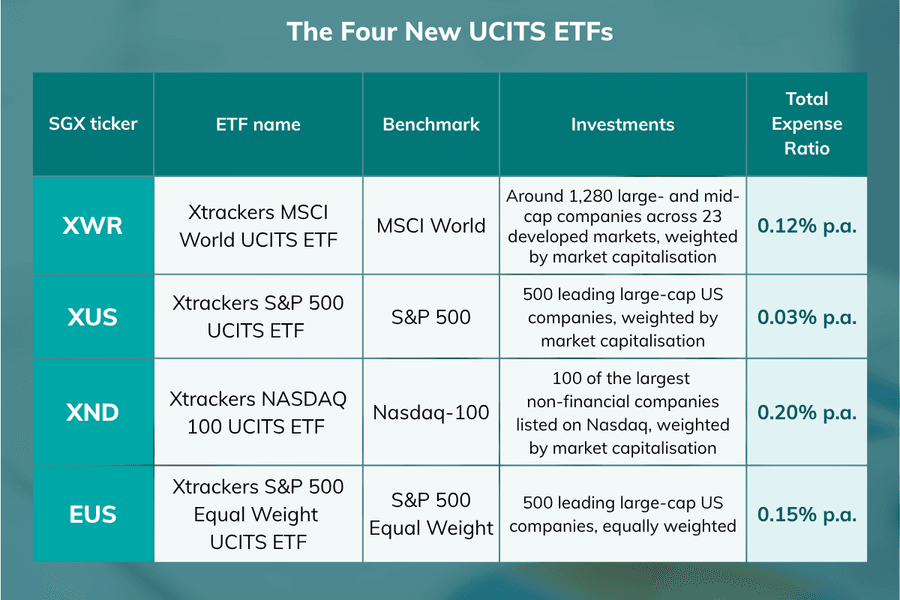
From 13 October 2026, the following four indexed ETFs, domiciled in Ireland, will be listed on SGX for trading via all major brokers that offer Singapore equities trading capability. Prior to that, they are available exclusively on Moomoo, with the advance subscription for Xtrackers MSCI World UCITS ETF (XWR) closing on 30 September 2026 at 12 noon, and the other three ETFs on 1 October 2026 at 12 noon.
Choosing Among the ETFs
The key principles for a successful investing experience over the long term are low cost, staying invested (non-market timing, or market-following) and diversification.
Among the four ETFs, XWR is a top choice to be a core building block of a long-term investor's portfolio. It contains over 1,000 stocks from 23 countries. Diversification works because we cannot predict with certainty who the biggest losers or biggest winners – among countries, sectors or companies – will be over time. It helps us to avoid chunky losses, while keeping a line in the water to always catch the winners.
Note, however, that XWR tracks only the developed world index, without the emerging markets. A more truly global index would be the MSCI All-Country World Index (ACWI), which is roughly 90% developed markets and 10% emerging markets. There is currently no such ACWI index fund authorised or recognised by MAS for retail offering in Singapore: you would need to build it yourself by pairing a developed markets index fund/ETF with an emerging market index fund in the right proportion. You can visit MoneyOwl's OwlInvest page to find out how to construct an all-equities, all-country portfolio.
A reminder here that not everyone should invest purely in equities. You should take a short risk profiling test of four questions using our free tool to find out which asset allocation suits you best.
Besides the global Xtrackers, I will also give "honourable mention" to the Xtrackers S&P 500 fund (XUS), which tracks the large-cap US stock index at a very low cost. Many investors love the S&P 500 because the US market has outperformed over the last decade and more, which is a recency effect. But we know that past performance is not a guarantee of future performance – for either stocks or countries. The diversification benefit is thus weaker when we go for the US market only. Overall, it is still an acceptable option to which some allocation may be made, because of the global nature of the top US companies.
On the S&P 500 Equal Weight strategy – this may be where the diversification concept is applied wrongly, or at least with sparser evidence. The usual thesis is that these 500 biggest companies are quality companies but there is discomfort with only a few companies driving returns in market capitalisation-weighted indices, so it feels more diversified to reduce the biggest weights. The reality, however, is that there has always been a skew in stock market returns being driven by only a handful of companies. In a recent seminal study covering 100 years of US stock market returns, Hendrik Bessembinder found that just 46 out of 29,081 firms accounted for 50% of the total wealth created by the US stock market from 1926 to 2025. The beauty of buying the whole market through an indexed fund is that the few winners will more than make up for the mediocre majority. Given that there is no real evidence to suggest that this structural dynamic is changing, you may want to think twice about emasculating your winners through an equal weighting.
At the same time, we do not know if all the winners will be in technology. (This is the correct application of diversification.) Over long periods, sector leadership changes, and it is difficult to time when that might happen. Hence, I would give the Nasdaq ETF that is concentrated in technology a miss, or at most allocate only a small portion to it.
Costs, Risks and Access: New Xtrackers UCITS ETFs Compared to Other Products
There are various instruments – or "wrappers" – that Singaporeans can buy to access low-cost global equities or US stock market indexed exposure, of which the Xtrackers UCITS ETFs are the latest.
How do they compare against one another? What are the pros and cons of choosing the Xtrackers UCITS ETFs?
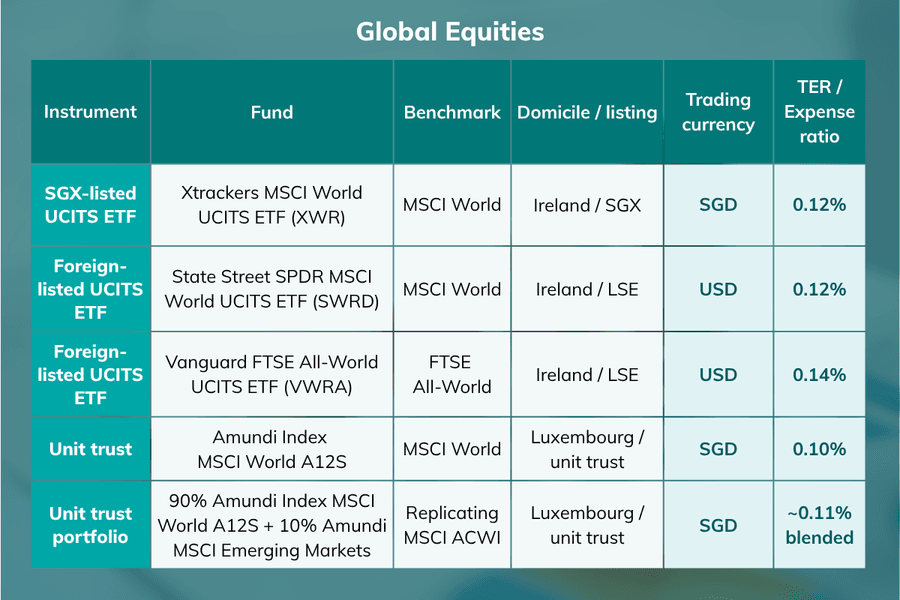
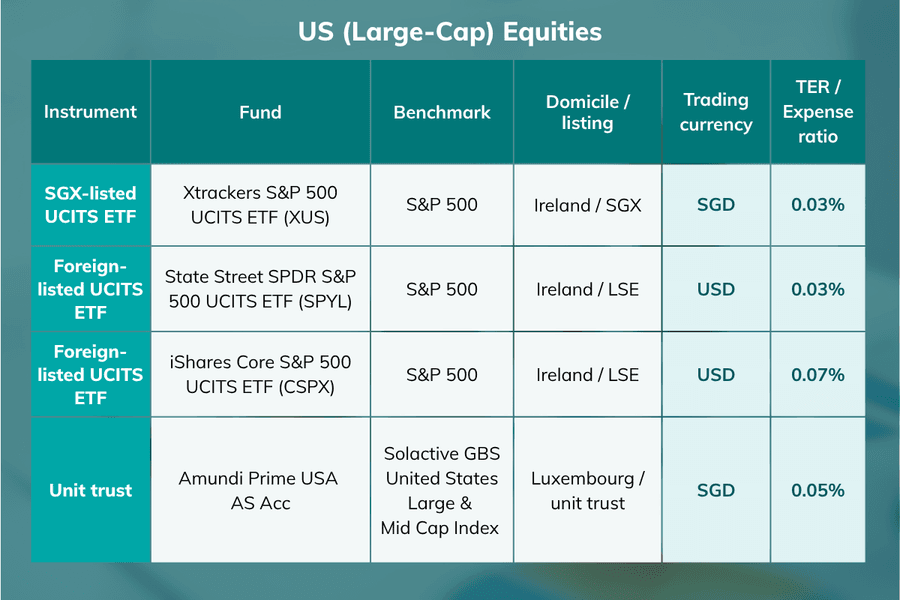
A quick glance would show us that the TER, or fund-level expenses, are not vastly different across the instruments. The Solactive benchmark is also very similar in composition to the MSCI benchmarks. All these funds, including the newest Xtrackers, do physical replication of the indices, which is preferred to synthetic replication.[1]
However, there are various considerations other than TER to take into account – other "hidden" costs, risks, and the practicalities of access.
Costs and Risks
1. Dividend withholding tax: One of the biggest advantages of the Irish Domiciled UCITS ETFs is the savings on dividend withholding tax compared with investing in US-domiciled ETFs. UCITS stands for "Undertakings for Collective Investment in Transferable Securities". Under the US–Ireland tax treaty, UCITS ETFs generally incur 15% withholding tax on dividends from US companies that they hold in the ETF. In comparison, dividends paid by a US-listed ETF may be subject to 30% withholding tax. To illustrate the potential difference, the average dividend yield of the S&P 500 is currently around 1.1%, a reduction in US dividend withholding tax from 30% to 15% would be about 0.16% p.a. which is multiples of the official fund TER. There are likely also savings for global developed market UCITS ETFs like XWR, given that US companies comprise about 70% of MSCI World.
2. US estate duty: Should you pass away suddenly and the value of your US-situated assets exceeds USD 60,000 at death, your estate will need to file a US estate tax return, and US estate tax of up to 40% could apply. The same will also apply to other US-domiciled ETFs listed in Singapore. The estate administration process may also delay beneficiaries' access to these investments. For the new Xtrackers ETFs listed in Singapore, there will be no estate tax for Singaporeans (except for US persons and barring other liabilities – consult your own tax adviser) and the probate process should be much smoother, especially with a will.
3. FX conversion costs: When investing in an ETF or unit trust denominated in a foreign currency, either on the local exchange or platforms or on overseas ones, you may incur a currency conversion cost if you need to exchange SGD to buy it, and again when converting the proceeds back to SGD. This cost may be built into the exchange rate offered by your broker or platform. Some robo-advisers have estimated this spread to be 0.30% to 0.80% for each transaction – again, multiples of the TER. The new Xtrackers ETFs being SGX-listed and denominated in SGD, as well as the Amundi unit trusts, avoid FX conversion costs.
4. Liquidity and bid-ask spreads: ETFs trade on an exchange, so investors buy at the asking price and sell at the bid price. The spread varies by ETF and can be affected by the liquidity of its underlying holdings, market conditions and market maker activity. For investors who buy and hold for the long term, this should be less of a concern, though it would still matter eventually if the spread is too large and liquidity too thin – so this remains a residual risk for retail investors. Investors should check the live bid and ask prices for the specific ETF before trading, including whether enough units are quoted for the amount they wish to buy or sell. Amundi unit trusts do not have a bid-ask spread. However, their dealing price may reflect swing pricing,[2] which adjusts the fund's net asset value (NAV) for the costs associated with investor subscriptions or redemptions.
5. Brokerage and platform costs: Buying and selling an ETF may incur brokerage commissions and other trading fees depending on the platform you use. Some charge a flat fee per transaction, others a percentage of funds invested, with multiple variations. The general pattern is that transaction costs tend to be higher as a percentage of assets for smaller investment amounts, including for regular savings plans. In comparison, the Amundi unit trusts can now be bought without any further extraneous sales charge, advisory fee or platform fee from POEMS – an arrangement that came out of MoneyOwl's approach to Phillip Securities as part of our social mission to catalyse solutions, with no commercial payment to us.
Access
6. Cash, SRS, CPF-Investment Scheme: The new SGX-listed ETFs can take cash and SRS. Foreign-listed ETFs can only be invested in with cash. The Amundi unit trusts can take CPF-OA monies, on top of SRS and cash.
7. Number of platforms that carry the products: ETFs can be accessed on many broker platforms that are members of the relevant exchange. For XWR and XUS, there will be choices for investors who may prize differentiating factors such as user interfaces and user experience from 13 October 2026 onwards, after the exclusivity period with Moomoo expires. For the Amundi unit trusts, only POEMS is offering them for DIY investors at no other fees. There are robo-advisers and human advisers who will carry the unit trusts, but at access/advisory fees between 0.30% and 1.00% p.a.; some will also charge an upfront sales charge or implementation fee.[3]
8. Minimum investment amounts: The four new Xtrackers ETFs will be listed and traded on SGX from 13 October 2026 and will trade at the prevailing price of 1 share. However, during the initial offer period, subscriptions are available exclusively through Moomoo (from 21 September 2026 to 30 September 2026 at 12 noon for XWR, and 1 October 2026 at 12 noon for the other three ETFs). The minimum initial investment is S$1,000. For the Amundi unit trusts, the minimum investment through POEMS is S$1 for cash and S$100 for SRS and CPF.
9. "Automated" regular savings plans (RSPs): One of the most important "kung-fu" moves in wealth accumulation is to automate regular investments, for dollar-cost averaging and to take the emotion out of investing. For SGX-listed ETFs, at the time of writing, monthly RSPs are offered by Fundsupermart and POEMS, as well as by various banking platforms. For foreign-listed ETFs, a few brokers and banks offer the facility. You should check for minimum amounts and for charges. For Amundi unit trusts, POEMS offers RSPs from a monthly investment amount of a minimum S$100 for cash, CPF and SRS, with no charges.
10. Redemption settlement dates: When you sell an ETF on SGX, you can see the quoted bid price before placing your order. The price you receive is confirmed when the order executes, and the trade settles on T+2. The Amundi unit trusts are traded based on the daily NAV. The applicable NAV is not known when you submit an order and is published on the following business day. Depending on the platform that you trade with, the cash proceeds from your redemption can take up to T+7 days.
A Good Option for Investing Globally from Home – If Used Wisely
In summary, the new Xtrackers UCITS ETFs are a good development for Singapore investors. They bring a new way of accessing good, low-cost and diversified investing, available through multiple platforms.
Compared to foreign-listed ETFs, the Xtrackers UCITS ETFs may be a superior option, because of the UCITS structure and SGD denomination. Besides the withholding tax advantage of the UCITS structure, I would also pay attention to the potential risks of a sudden death – in terms of either estate taxes or access to assets. The SGD denomination adds hidden FX costs and also creates difficulty for Singapore residents in assessing their true costs and net worth. That said, it is important to note that being SGD-denominated is not the same as being SGD-hedged, so you are still subject to currency risks.
Relative to the Amundi unit trusts, which also do not have the sudden death-related risk or the FX issues, the score is more neutral. The Amundi funds' key disadvantages are in access-without-fees being limited to only one platform, POEMS, and a clunkier and slower settlement process. Cost-wise, while the Amundi funds have a higher withholding tax, investors making small or regular investments may still find them more suitable, depending on the structure of the actual platforms being used.
There are two key risks with the Xtrackers. On the ETF side, there is a question of whether they can sustain enough liquidity and a tight enough bid-ask spread. This needs to be monitored over time. Behaviourally, because an ETF trades in real time, investors may be tempted to trade them based on newsflow and emotion, interrupting the compounding power and increasing transaction costs.
On balance, the new UCITS ETFs, especially XWR, can benefit long-term investors in Singapore, provided that they do not trade them. At the same time, there is no need to rush to catch the promotional period, or to move wholesale into the ETFs. From 13 October 2026, many major brokers will be offering the ETFs, and you can always buy the ETFs then.
Note: MoneyOwl is not paid by anyone or any entity to write about these ETFs. We are a professional and licensed adviser, but we do not do any direct selling of financial products.
Disclaimer: While every reasonable care is taken to ensure the accuracy of information provided, no responsibility can be accepted for any loss or inconvenience caused by any error or omission. The information and opinions expressed herein are made in good faith and are based on sources believed to be reliable but no representation or warranty, express or implied, is made as to their accuracy, completeness or correctness. All investments carry risk. Expressions of opinions or estimates should neither be relied upon nor used in any way as an indication of the future performance of any financial products, as prices of assets and currencies may go down as well as up and past performance should not be taken as an indication of future performance. The author and MoneyOwl shall have no liability for any loss or expense whatsoever relating to investment decisions made by the reader.
This publication has not been reviewed by the Monetary Authority of Singapore.