
Interest rates are up: Should you pay down your debt now?
29 SEP 2026
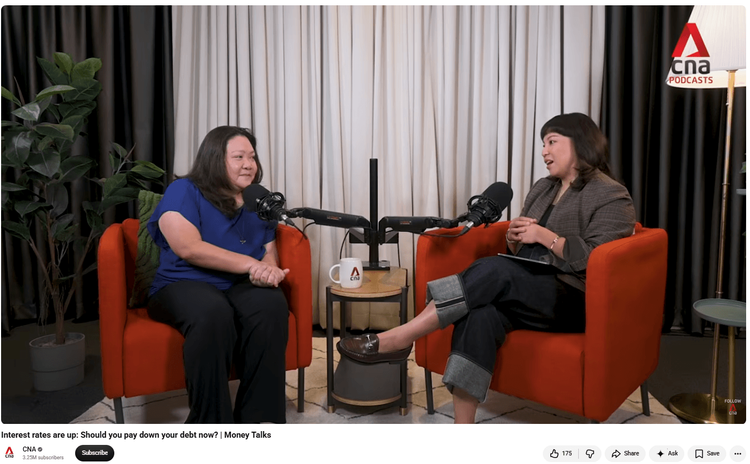
CNA Money Talks podcast – The US Federal Reserve has raised interest rates, prompting questions about what higher borrowing costs could mean for Singapore households and whether spare cash should go towards paying down debt or investing. The conversation covers good versus bad debt, a four-part framework for deciding, and how the answer shifts at ages 30, 40 and 50.
MoneyOwl's CEO and Chief Investment Officer, Chuin Ting Weber, explains that good debt buys a proper asset that pays off in future, is stable, comes without restrictions and carries a low interest rate, such as a home or a student loan (an investment in one’s human capital). Credit card debt at about 28 per cent is bad debt and should be cleared first. Repaying a good debt does not make anyone rich, and waiting to invest only when debt is cleared forfeits years of compounding.
The four Rs help decide between repaying and investing: (1) Restrictions, such as lock-ins and prepayment penalties; (2) Returns, comparing interest saved with what the money could earn, net of penalties; (3) Risk, holding on to the debt and risks incurred when paying off debt; and (4) Relief, the psychological weight of debt. Clearing debt for relief is worthwhile provided the other three Rs line up.
This includes keeping liquidity. Prepaying a mortgage turns cash into an illiquid asset for a spread of perhaps 10 to 20 basis points over Singapore Savings Bonds, leaving little cushion after a retrenchment, so an emergency fund of at least six to nine months of income should come first. The Fed's hike does not feed directly into Singapore borrowing costs, but some mortgage rates have crept up by 20 basis points in the past month. As rate forecasts are too unreliable to plan around, a fixed rate that can be comfortably afforded matters more than predicting where rates go.
Chuin Ting also cautions against copying the leveraged spread plays of the wealthy, such as premium financing to buy insurance policies and bonds, which are risky in the mass market where the instruments on offer include dividend-paying ILPs. Near retirement, a CPF SA top-up (4 per cent) or a voluntary housing refund to the OA (2.5 per cent) both beat current mortgage rates, and preserve options.